Running and Philosophy
A Language of God adventure

Each year Calvin University in Grand Rapids hosts the “January Series” in which a diverse group of speakers are brought to campus for lectures that are open to the public. The podcast team at BioLogos reviews the list of announced speakers each fall to see if there are any we’d like to nab while they’re in town for an in-person interview. This year the one that jumped off the list for me was Sabrina Little.
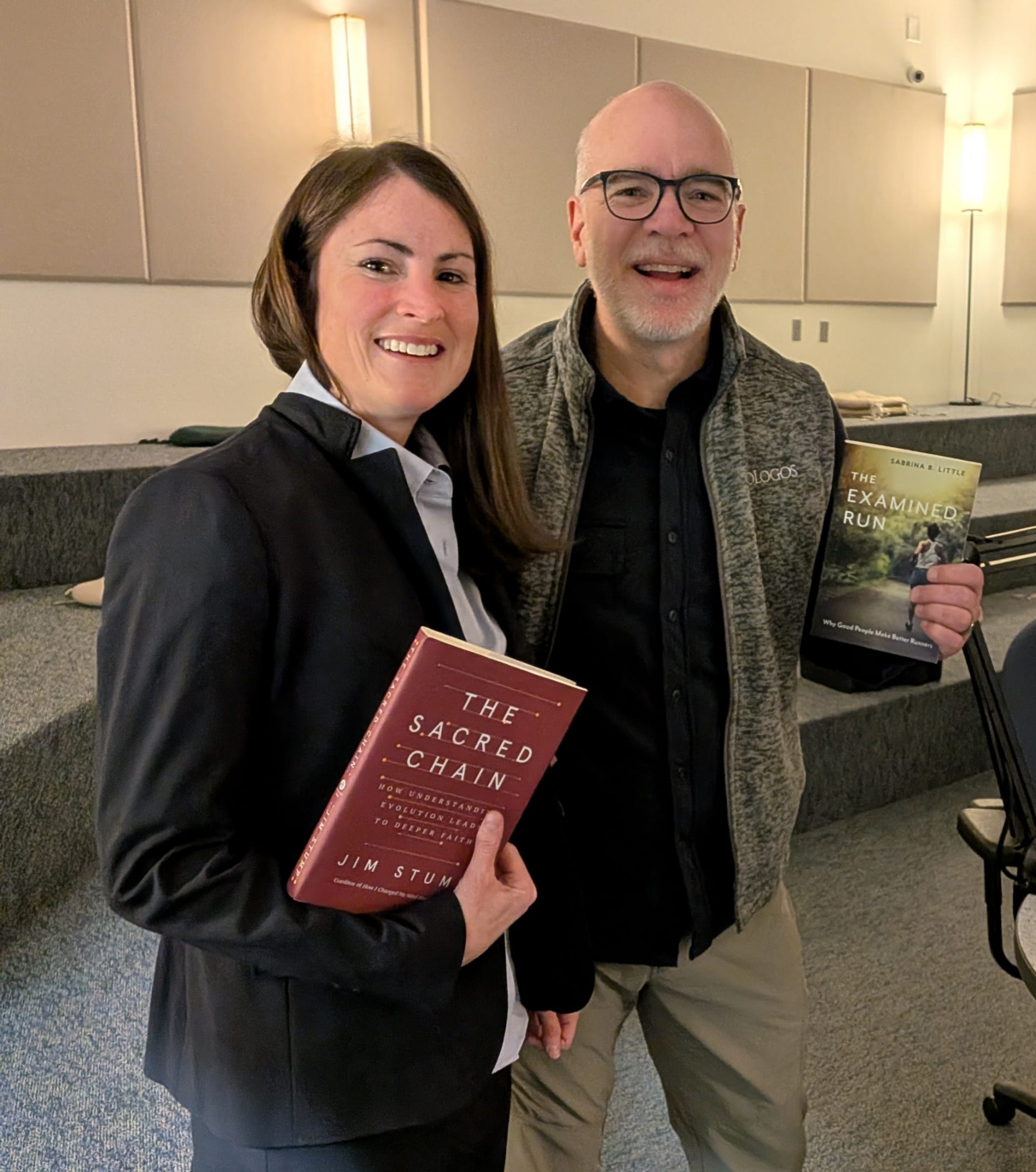
It wasn’t her name that did it for me (I confess that I didn’t know her), but rather her bio: she’s a philosopher and an ultra-marathon runner who has written a book called The Examined Run: Why Good People Make Better Runners. I ordered it immediately and we scheduled an interview on campus.
I don’t really live in the full-time world of professional philosophy any more. I rarely write journal articles and never grade papers anymore; I would not be competitive for most positions listed in “Jobs for Philosophers” (yes, that’s a real publication… though admittedly not a very long one). But being on Calvin’s campus makes me think there might be some kind of eternal security for philosophers: once a philosopher, always a philosopher. I’d like to think I still maintain some of the habits of mind of a philosopher: when I write, interview guests for the podcast, or try to make sense of big questions about science, faith, and human nature, I’m relying heavily on that earlier training. Philosophy was never just about the academy; at its best, it’s about learning how to think carefully about the most important questions in life.
I have also been a runner — at least in the technical sense of having been one who has run. I was a middling runner on my middling cross country team in high school. As an adult, I sporadically got more serious about running, even completing a couple of marathons. But there’s not really eternal security for runners. I’m an Arminian about running and acknowledge that minor but nagging injuries have me currently in a state of backsliddenness.
Sabrina Little doesn’t need to worry about those theological metaphors for either her running or philosophy. She is a five-time national champ in distances beyond marathons, and even held the American record (twice) for the 24-hour race (which is just what it sounds like: you start running at 9am, and whoever has gotten the furthest by 9am the next day wins… she went 152 miles!). Now, she’ll tell you that she’s not quite in that shape now — she has birthed three kids over the last few years. Still, the very cold January day that I interviewed her, she got up and ran. And she has her sights set on making the Olympic marathon trials, noting that that race is twenty-one and a half hours shorter than the twenty-four hour races she used to do, so it fits her working-mom-lifestyle a little better.
She works as a professional philosopher, and this book she wrote is published on Oxford University Press. Rather than treating running as merely a test of physical ability, she thinks of it as a kind of laboratory for thinking about character and what it means to live well. It brought all kinds of interesting questions to my mind that I got to ask her about:
What are the similarities and differences between sports and religion?
Is running better at developing virtue than other sports?
Is virtue like athletics, where everyone can get better by practicing, but some people obviously have more natural ability?
Are carbon plate running shoes cheating?
Is all suffering (in running and regular life) virtue-enhancing?
About that last one: in sports culture, it’s common to see team t-shirts with slogans like “no pain, no gain,” or hear the claim about a race that whoever can suffer the most will ultimately win the race. Sabrina pushed back against that kind of thinking. Not all suffering is equal, she argued. Some forms of difficulty are part of the process of growth — like the strain involved in developing patience or perseverance. But other forms of suffering are simply the result of poor judgment or unnecessary harm.
The challenge, then, is learning to distinguish between the kinds of difficulty that help form our character and the kinds that merely damage us. That distinction matters in athletics, but it matters just as much in the rest of life.
I may not be logging many long runs these days. Walking and hiking have become my more common mode of bipedal recreational tranport. But they are conducive, too, of developing virtues, or at least of philosophizing. I can’t help (in an irresistible grace kind of way) of asking while I amble about: What kind of person am I becoming? And what kinds of practices might help me become more of what I want to be tomorrow than I am today?
Our episode with Sabrina Little came out last week. You can listen to it here, or wherever you listen to podcasts under the Language of God feed.
Great discussion. Just a few thoughts.
Running long distances and being alone with one's thoughts reminds me of the spiritual discipline of solitude/silence. That's something non-athletes can take away from Dr. Little's experience as a runner.
In terms of all sports being "formative space" for virtue, I agree. My dad died when I was a young man, and going through his things I found his spiral notebook for teaching Sunday School. Among his last lessons was, "God Is a Football Fan." I had to laugh because he would be sitting in the choir visibly irritated if the pastor ran past noon when the Cowboys were playing, but the substance was virtue formation. I was lucky to have him as a dad.
Finally, whew!, I would add that I spent a decade teaching in juvenile detention, and I rarely ran across a kid who participated in sports, either in middle school or high school. I remember some research that this was particularly true of girls. Neither of my kids were particularly gifted, but I kept them involved in sports until they found other interests in high school.