Packing for Contradictions
An ANWR adventure

Today is packing day.
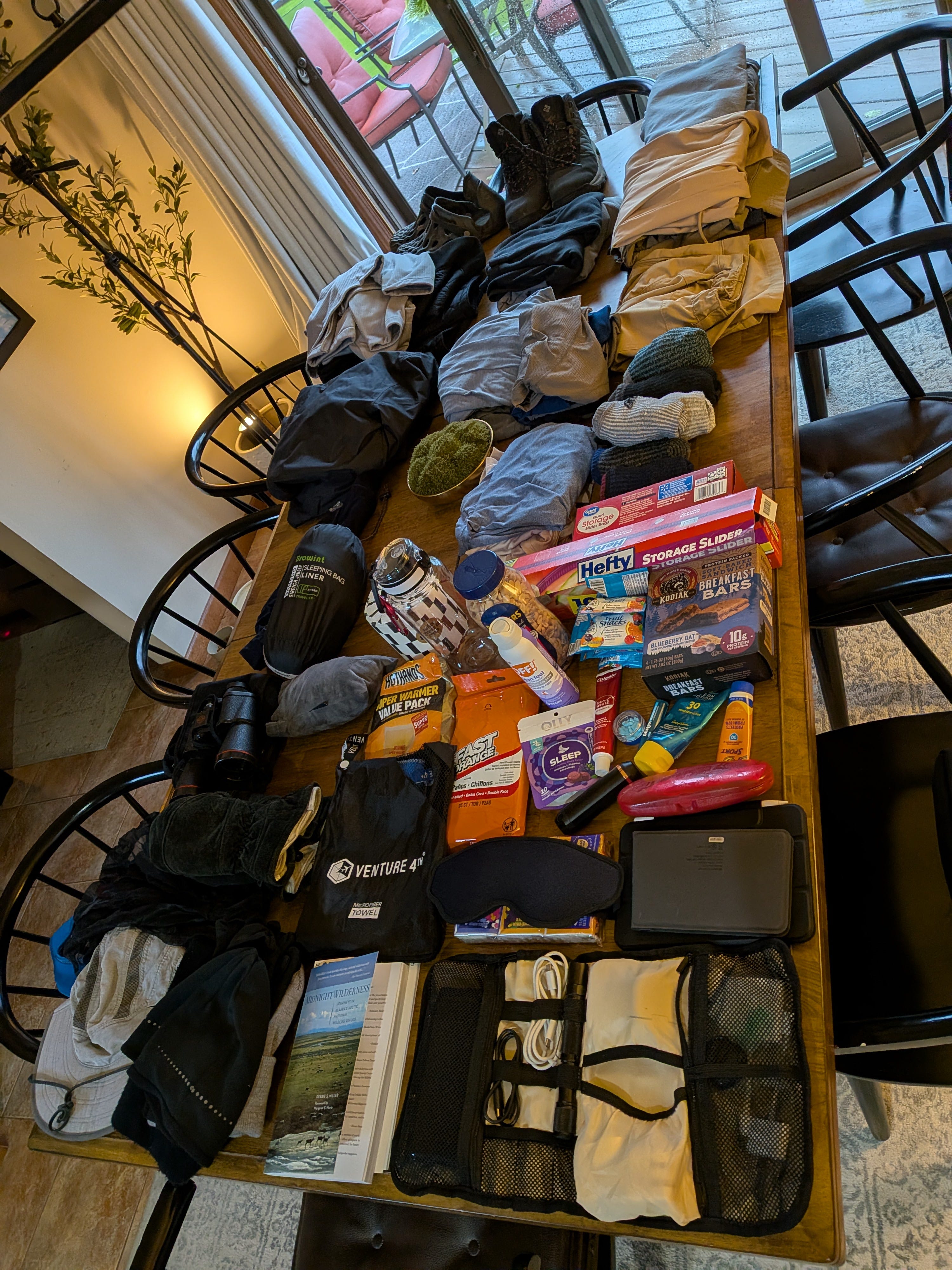
This is the stage of a trip when adventure is starting to feel real but mostly spread across the dining room table in little piles.
There is the pile of wool things. The pile of waterproof things. The pile of “surely I won’t need this but will deeply regret not bringing it if I do” things.
Tomorrow afternoon I’ll take the train to Chicago and fly out from there early Friday morning to Fairbanks (there was no option to get me from my cute little South Bend airport to Fairbanks in time for dinner). There all of this will be transferred into waterproof gear bags and then into tiny planes headed further north that will carry it and me to the Arctic National Wildlife Refuge.
The packing list for staying in ANWR is, among other things, an exercise in contradiction:
Shorts and long underwear.
Sunscreen and hand warmers.
A sun hat and a neck gaiter.
Wool socks and a mosquito net.
I checked the nearest weather station I could find to where we’ll be camping: Point Thomson Airstrip, near the coast of the Arctic Ocean. It was 27 degrees there today.
Twenty-seven. In the middle of June.
Now, Point Thomson is near the coast, and the Arctic Ocean is presumably still doing its best impression of a very large ice cube, so perhaps ten or fifteen miles inland it will be warmer. Maybe even balmy. Perhaps 39 degrees. I assume this is why the packing list includes both sunscreen and thermal layers, which feels less like practical advice and more like a dare.
But the weather is probably only the first of many contradictions. That, I suspect, is part of what this trip is going to be about.
I am going to ANWR with a group of faith leaders at the invitation of the American Lands Project. We are going to see one of the largest protected wilderness areas in the United States, a place most Americans will never visit and many of us know mostly as an acronym in political arguments.
ANWR contains caribou, birds, bears, rivers, tundra, mountains, and astonishing seasonal life compressed into a brief Arctic summer. It also contains oil. Quite a lot of it, depending on the estimate. Something like five to ten billion barrels may be recoverable beneath parts of the refuge.
That sounds like an almost unimaginable amount of oil. It is also, roughly speaking, about what the United States burns through in a year.
How does that fact land with you? Because the question becomes: would we permanently alter one of the wildest protected places left in this country for one more year of our current way of life?
I know that is too simple. Most moral questions worth asking are much more complicated — even “wicked” in the technical academic sense, which Wikipedia defines as: difficult or impossible to solve because of incomplete, contradictory, and changing requirements that are often difficult to recognize. There’s that word again: contradictory.
Energy is not an abstraction. Jobs are not abstractions. Local communities are not abstractions. The people who live in and near these lands are not characters in someone else’s environmental parable. They have actual lives, actual histories, actual disagreements, actual hopes for their children.
That may be the contradiction I am most eager, and most nervous, to learn more about.
Many of us who care about wilderness are tempted toward a very romantic picture of Indigenous subsistence communities. We imagine people living in perfect harmony with the land, needing nothing from modernity, wisely preserving ancient ways while the rest of us doomscroll and buy rechargeable toothbrushes.
There may be truth in parts of that picture. But there is also danger.
Subsistence living is not a lifestyle brand. It is not a curated alternative to suburban malaise. It can be beautiful, skillful, communal, and deeply connected to land and animal life. It can also be hard, precarious, and costly. Many families around ANWR still depend on migrating caribou for meat. Many also want reliable jobs, health care, infrastructure, and the ability to decide their own future.
It is not my job to turn them into symbols.
And yet, if you look at a place like Prudhoe Bay on Google Maps’ “streetview”, you can see another future of what was once wilderness: Roads, cement pads, gas tanks, machinery, scars. The visual artifacts of extraction. A place reorganized around what can be taken from beneath it.
I say that without any claim to purity. I am writing these words on a machine made possible by mining, manufacturing, shipping, energy, and all the invisible systems that make modern life modern. My boots, jacket, phone, Ziplock bags, moisture-wicking underwear and battery pack / handwarmer combo (which I didn’t even know existed, but once the algorithm figured out was I was doing and served it up to me, I couldn’t resist) are all conveniences (or luxuries) of the very world I am preparing to critique. I’m not advocating that we all go back to wearing last year’s caribou skins as we try to chase down enough for us to survive another year.
The contradictions are not only out there. They are in my pack. They are in me.
That is probably the right posture for this trip: not certainty, not innocence, not the clean moral satisfaction of knowing exactly who the villains are.
I am bringing questions:
Why should we care about a place most of us will never see?
Why should we care how the plants and animals are doing there?
What does it mean to protect a refuge?
Is there a better way to understand a place like ANWR than as a resource waiting to be extracted?
That last question is the one that keeps the contradictions alive in mind. The word “resource” is not wrong, exactly. We are embodied creatures. We need food, shelter, heat, transportation, tools, energy. To live is to use resources from the world.
But something happens to us when “resource” becomes the primary way through which we view the world:
A forest becomes timber.
A river becomes power.
A mountain becomes minerals.
A refuge becomes oil.
And once that translation happens, it is hard to translate back.
The theological word I want to hold beside “resource” is “creation.”
Creation is not a denial of usefulness. Creation feeds us, shelters us, warms us, carries us, and sustains us every day. But creation means the world is gift before it is commodity. It means the world has value before it becomes valuable to us. It means there are limits to what we should take, even when taking is possible.
That sounds simple when written from a desk. I expect it will feel less simple on the tundra.
I hope it does.
I hope this trip complicates me in the right ways. I hope I hear things that do not fit neatly into my existing categories. I hope the land itself corrects some of my abstractions. I hope the people we meet do too. That is, after all, at least part of why we go somewhere rather than merely having opinions about it from a comfortable distance.
So today I am packing for contradictions: For cold and sun, for mosquitoes and hand warmers, for reverence and discomfort, for the desire to protect wilderness and the knowledge that my own life runs on extraction.
I am packing things that will help me see: binoculars, camera, notebook, extra batteries, enough layers to keep me from becoming a cautionary tale for the next group. But I hope I am also packing a willingness to be unsettled. Because maybe the work of witness is not to arrive with everything already resolved. Maybe it is to pay attention long enough that the questions become more honest.
The gear will go into waterproof bags. The contradictions, I suspect, will have to come with me unpacked.
I’ll try to write one more post from Alaska before escaping out from under the cell phone coverage that connects us and controls us.
Jim,
Next week I also will be heading to Alaska on a Mennonite Disaster Service assignment in a remote village near the Bering Sea for a month. Your questions and contradictions resonate with me. I look forward to comparing learnings.