NT Wright: Scars, Gold, and the Future of the World
A Language of God Adventure

I should say before getting started that my job is not all fun and games. There are spreadsheets, meeting, budgets, and grant reports. There are lots of emails that seem to reproduce in the night like rabbits
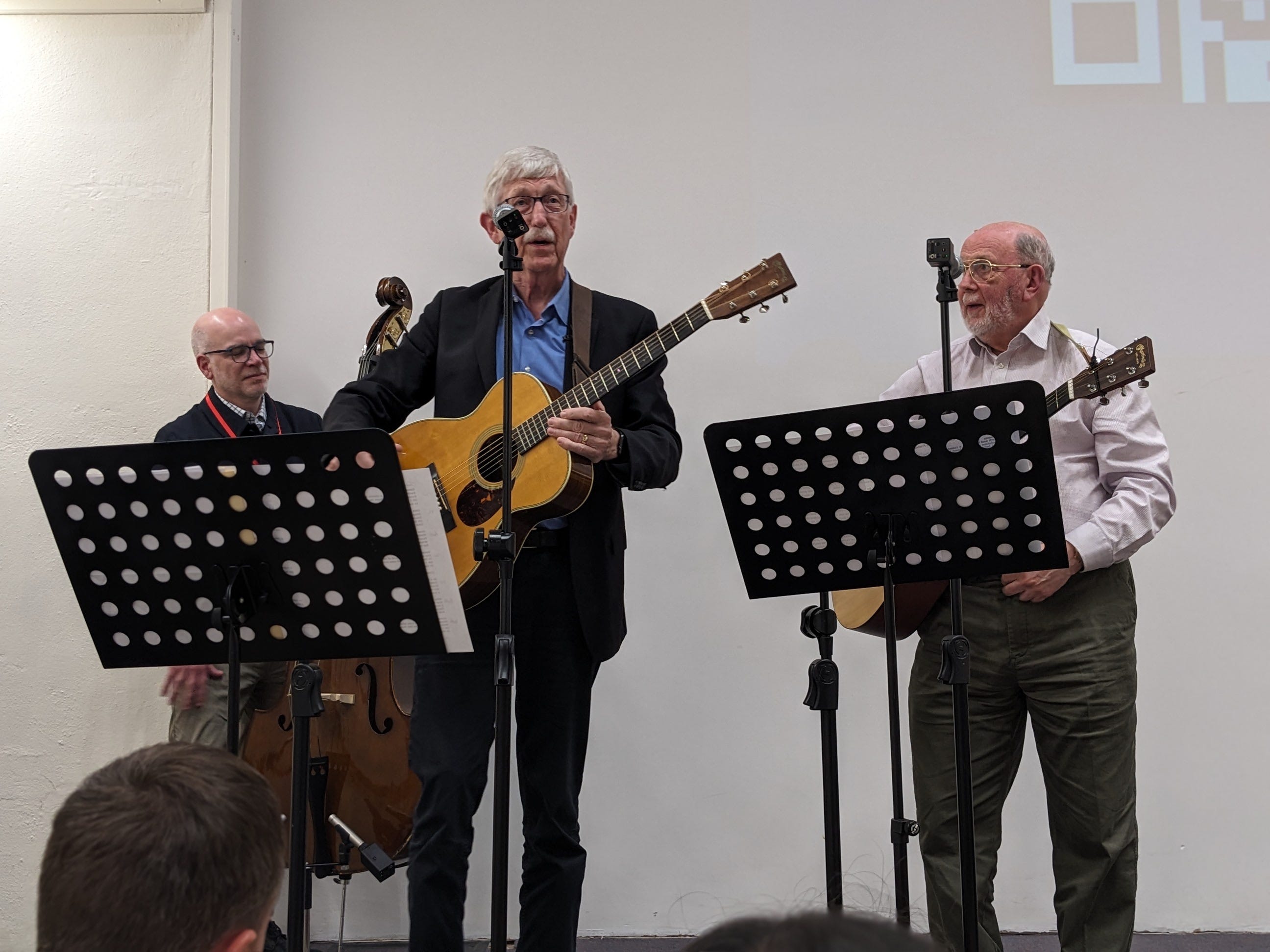
But sometimes the job is really fun. A couple of Substack posts ago I told you about what may have been the highlight of my musical career: playing bass behind Francis Collins and N. T. Wright while they sang Leonard Cohen’s “Hallelujah,” with verses rewritten by Tom for a science-and-religion crowd. (That is not a sentence I expected to write when I began my professional life.)
At the end of last week’s Language of God episode, we included a recording of that song. You can hear Francis and Tom singing. You can hear the room enjoying it. And, if you listen carefully and charitably, you can hear me on bass, trying very hard not to ruin the experience.
Right before that happened, I sat in Tom Wright’s office at Wycliffe Hall in Oxford and interviewed him for the podcast. That was pretty cool too.
Tom Wright has been one of those theologians I’ve read and reread over the years. I don’t always agree with him on every detail, but his work has shaped me profoundly, especially on the question of eschatology and Christian hope.
Colin and I went to Tom’s office at Wycliffe Hall and sat down with him for a conversation about Scripture, history, resurrection, hope, and the renewal of creation. Which is to say, a typical Friday in Oxford.
For many of us, the word “heaven” still conjures images that owe more to cartoons than to Scripture: harps, clouds, disembodied souls, that kind of thing. An eternal worship service in the sky, which, depending on your childhood church experience, may sound either glorious or the most boring existence ever.
Wright’s book Surprised by Hope helped many of us recover something much closer to the biblical picture: not escape from the world, but the renewal of the world.
Not: “this place doesn’t matter because we’re leaving.”
Rather: “this place matters because God is not done with it.”
That shift is not a minor theological adjustment. It changes everything, because if the Christian hope is not that our souls fly away to a better place, but that God renews creation, then the question becomes intensely practical: What are we doing here and now that points toward that future? Or maybe: What are we doing here and now that works against it?
This has been a live question for me for a long time, especially as I’ve thought about climate change. I don’t mean “live” in the sense of an abstract puzzle that philosophers thrive on. I mean “live” in the sense that it keeps breaking in and interrupting me when I’m trying to do other things.
If we believe that God loves this world, that God called it good, that God intends its renewal rather than its abandonment, then Christian hope cannot be a way of numbing ourselves to what is happening to the planet.
Hope is not optimism. I’ve said that before in these pages, and I will probably keep saying it until someone makes me stop.
Optimism says: “It will probably all work out.”
Hope says: “God is faithful, and therefore our work is not in vain.”
Those are very different things. Optimism requires favorable odds. Hope can look directly at the wound and still refuse despair.
That brings me to the question I was most excited to ask Tom, which comes from a metaphor (which may also have been reality) that has become increasingly important in my own thinking: the scars on Jesus’s resurrected body.
The resurrection of Jesus is not a magician’s trick. It is not God saying, “Never mind that old body; here’s a shiny new replacement.” The tomb was empty. The body that had been crucified was transformed. There is continuity with what was before, and there was transformation of it into something else. The old made new.
And the risen Jesus still bore the marks of what had happened to him. That has always struck me as theologically provocative. The wounds were not erased. They were not airbrushed out of the resurrection body. They were taken up into glory.
So I asked Tom: might something like that be true of creation?
If the resurrection of Jesus is the paradigm for the renewal of all things, and if his resurrected body bore the scars of what happened to him in this world, then is it possible that what we do to the Earth now will somehow be carried forward into the new creation? Are we, by our violence against creation, placing wounds into the future?
You can hear the cautiousness in Tom’s voice about this. It was something he’d not considered before and “would have to be convinced of.”
This is one of the things I appreciate about him. He does not hear a metaphor and immediately baptize it just because it sounds interesting.
Fair enough.
But he also did not dismiss the instinct behind the question. There is, he said, a deep Christian tradition of seeing the wounds of Jesus as signs of glory. And there is a sense in Christian hope that nothing good is wasted. God takes things as they are and makes of them what God wills.
Then I brought up kintsugi.
Kintsugi is the Japanese art of repairing broken pottery with gold. The break is not hidden. The repair does not try to make the bowl look like nothing ever happened. The crack becomes part of the beauty.
Tom immediately warmed to that image. He knows and admires Makoto Fujimura, who has written beautifully about kintsugi, art, faith, and brokenness (and talked about it as a guest on the podcast several years ago). Tom said the image is deeply appealing from a Christian eschatological point of view. Where there has been breakage, there can be not merely healing, but beauty.
Not the elimination of brokenness, but the transfiguration of it. That seems right to me.
But there’s a necessary warning here, and Tom and I both named it: you don’t go around smashing bowls in order to make kintsugi.
This is where Christians can get themselves into trouble. A theology of redemption must never become an excuse for harm. “God can bring beauty out of brokenness” is true. “Therefore brokenness is no big deal” is false. Dangerously false. Wickedly false.
The fact that God can bring resurrection from crucifixion does not make crucifixion good. The fact that God can bring beauty from ecological devastation does not make ecological devastation acceptable. The fact that creation may one day be healed does not give us permission to wound it.
This is especially important when we talk about climate change. Some Christians still seem to think that because God will renew creation, our treatment of the Earth is spiritually irrelevant. That is exactly backwards.
If God intends to renew creation, then creation care is not a side issue for Christians. It is a signpost. It is one of the ways we live now in anticipation of what God will do then.
Tom put it this way in the interview: if we pray for the renewal of creation, the question comes back to us: what are we doing about that right now? Not because we bring the kingdom by our own efforts. We don’t. Not because recycling our yogurt containers will usher in the new heavens and new Earth. It won’t. (Though, for the record, rinse them first. We are not animals.) But because the things we do now can be genuine future-pointing signs of new creation.
That phrase has stayed with me: future-pointing signs. This is where Christian hope becomes wonderfully inconvenient, because it means that the future is not just something we wait for. It is something we witness to.
When we work for justice, we are pointing toward God’s future. When we make peace, we are pointing toward God’s future. When we care for the poor, heal the sick, welcome the stranger, teach a child, plant a tree, restore a wetland, feed the hungry, or sit beside someone who has no idea how they’re going to make it through the week, we are not just doing “nice things.”
We are practicing resurrection. We are rehearsing the world to come. And we may not know which of these acts matter most.
Tom made this point beautifully. At the end of 1 Corinthians 15, after Paul’s great chapter on resurrection, Paul does not say, “Therefore, sit tight until God gives you your new body.” He says, in effect, get to work, because your labor in the Lord is not in vain.
That is one of the most important “becauses” in the Bible. Resurrection does not make present action meaningless. It makes it meaningful.
It may turn out that the things we thought were most impressive were not the things that mattered most. The big public accomplishments, the books, the buildings, the platforms, the Very Important Initiatives (with capital letters) we write grant proposals for — maybe some of that matters. Maybe some of it was mostly God keeping us busy and out of mischief.
Perhaps the cup of cold water mattered more. Perhaps the quiet act of mercy mattered more. Perhaps the unnoticed work of repair mattered more.
That is both humbling and liberating.
It is humbling because we are not in a good position to judge the ultimate significance of our own lives and work. It is liberating because nothing done in love is wasted.
Not the work of justice.
Not the work of creation care.
Not the work of telling the truth when lies are more profitable.
Not the work of making beauty in a world addicted to utility.
Not the work of hope when optimism has run out of gas.
This, I think, is why Tom’s vision of the afterlife continues to matter so much. Bad pictures of the future deform our life in the present. If we imagine salvation as evacuation of Earth, then we will treat the world like a waiting room. Maybe keep it tidy, maybe not, but ultimately it doesn’t matter much because our flight will be called soon (I’m writing this from a lounge in the airport!).
But if the Christian future is resurrection and renewal, then the world is not a Delta lounge where you’re just waiting to go home. It is the raw material of glory.
Scars and all.
And maybe, by God’s grace, there will be some gold in the cracks.
Don’t forget to listen to the science and faith trio on the podcast episode! (If you feel like you’ve gotten enough of the conversation, you can jump to 44:25 for the song).
Wonderfully said Mr. Stump. It is hope like this that keeps me going even on the hardest of days. Some days I wonder if atheism is true. But the figure of Christ is too beautiful and loving for me to think so.
The line about not smashing bowls to make kintsugi is the part of the metaphor most often skipped, and Tom Wright's caution about it sits exactly where it should. Watching the work being done, what stays with you is that the kintsugi master is not adding beauty to the break — they are making the break visible. The gold is honest about what happened. It refuses the alternative repair, which is to hide the fault and pretend the bowl is what it was before. There is a Christian sentence somewhere in that distinction between concealment and acknowledgement, and your essay points toward it without rushing past the warning.