Ground(ed) Transportation
How many modes are there?

I’m in San Francisco, primarily representing BioLogos at a conference tomorrow—the Faith, Work & Tech second annual summit. But when you travel this far, it makes sense to bundle a few things together. So I actually flew in on Wednesday, had a full day of meetings Thursday down in Silicon Valley, and then today I had a couple of things scheduled in San Francisco proper.
I think I set a record—definitely a personal one, and I’m curious where this would land on the all-time leaderboard—for using the most different modes of ground transportation in a single day. That wasn’t the plan, but as the day unfolded I started seeing the possibilities, and when I had a couple of options late in the day, I chose the one that added another mode to the list.
I do more than my fair share of travel, often in the service of spreading the word about what we should be doing to limit the worst effects of climate change… which surely includes traveling less. I’ve written about that irony (or maybe it’s just contradiction) before. One consequence is that I try to be intentional about how I travel—not always choosing the mode with the lowest carbon footprint, because there are other considerations too. One of them is simply to see a place.
Travel is a tremendous opportunity to enlarge your horizons, to see the world through the lenses of other people. Taking different modes of transportation helps with that. It breaks you out of the narrow, often anesthetized experience of moving from one homogenous space to another.
So here’s my chronicle of ground transportation today.
The morning started early as I left my hotel in San Jose and drove my rental car back to the airport. Driving a rental car alone feels like the quintessential upper-middle-class thing to do.
At the airport, I wasn’t flying anywhere—I caught a shuttle van that runs from San Jose airport up to SFO. I’d needed a car in Silicon Valley for multiple appointments, but didn’t want one in the city, where parking is a hassle and public transportation is plentiful.
The shuttle driver was jovial, and the radio was tuned to an oldies station. The only other passenger was a very sleepy man who tested several seats before finding one that let him lean against the window and snore contentedly.
I was dropped off at SFO’s international terminal around 7:30 a.m. My hotel was just three miles away, and the only real option was Uber. My driver, Tuan, was pleased that I recognized his name as Vietnamese—less pleased when I said I’d had a classmate in high school named Tuan who was female. “No!” he said, “Tuan is a name for males, not females. Hers must have been a transliteration error.” Uber was once a transformative innovation, but I wonder how long it will last. It’s gotten absurdly expensive—my three-mile ride cost $35, almost more than all my other transportation combined today.
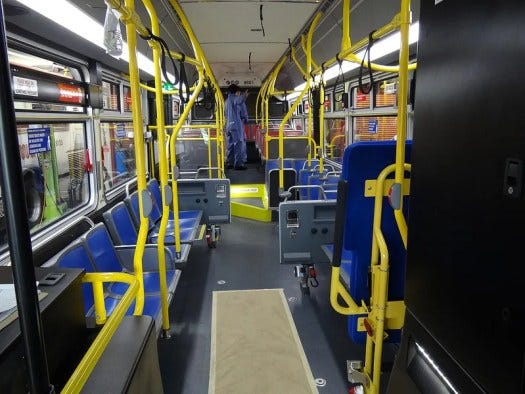
At the hotel, I couldn’t check in at 7:30am, but they took my suitcase. I sat in the lobby answering emails until it was time for my next ride: the city bus. For $2.50 I boarded the 292 right in front of the hotel and rode 45 minutes into the city.
This is how you see the guts (and underbelly) of a city. During grad school in Boston I rode the bus almost daily, but that was a mostly professional crowd—students and young workers. The 292 in San Francisco was a different scene. People in fast-food uniforms or cleaning-service gear. I was the only Caucasian on board the whole trip. Everyone looked tired, like life was hard—except for one woman who radiated joy. As soon as she boarded, she walked the aisle handing out tracts about the rapture, which were mostly written in Filipino. (For reasons I don’t understand, the section quoting “he that hath an ear, let him hear” was illustrated with clip art of a man carrying a trash bag and a toilet.) I smiled and thanked her.

I wish more people in my demographic would ride a bus like this now and then. It might help us normalize each other instead of “othering” each other. It’s not always comfortable. When I got off, four homeless people were lying nearby in various states of unconsciousness—some from sleep, others from the substances they were in the process of ingesting. It was sad, but not threatening. No National Guard troops were needed.
From there I walked five blocks to my meeting, in a hip new high-end coffee shop where my pour-over cost $12. Afterward, I ordered a driverless Waymo to my next stop. Quite the contrast from the city bus. No passengers. No driver. The service worker, too, has been replaced by AI. I’ve written about this before, and it now feels strangely normal.
Next came the trolley—because this is San Francisco. That crowd is almost entirely tourists, and I was one of them, having just watched the sea lions by Fisherman’s Wharf and eaten clam chowder in a sourdough bowl.
The trolley didn’t take me quite where I needed to go, so I hopped on a Lime scooter and zipped a mile and a half to the train station. The train took me—and a car full of commuters—back south to my hotel.
Recap: rental car, shuttle van, Uber, city bus, driverless Waymo, trolley, scooter, train. Eight ways of getting from one place to another—and eight different windows into the world.
Maybe that’s what struck me most by the end of the day. Each mode of transportation carried not just people but stories—different ways of being in the world. The more insulated the ride, the easier it is to forget that. Empathy depends on proximity, on brushing shoulders with lives unlike our own. It’s fallen on hard times lately, having been deemed toxic by people rationalizing their lack of it (IMHO). But maybe cultivating empathy starts as simply as choosing to ride the bus once in a while, to observe and listen (people-watching) instead of scrolling, to remember that the world is full of fellow travelers, all of us just trying to get where we’re going.
Tomorrow I’ll walk across the parking lot to the conference. The next day I’ll probably Uber to the airport, take two planes to South Bend, and drive my own car home.
May your travels be happy and worthwhile.