Back from the Arctic
An ANWR Adventure

I made it home.
After five days in the Arctic National Wildlife Refuge, the ordinary world feels a little strange. I have been back among buildings, roads, outlets, Wi-Fi, ice makers, traffic lights, and the ancient miracle of indoor plumbing, and I am trying not to act too startled by all of it.
Before the trip, I had imagined writing every day from ANWR. I thought I would keep a kind of daily journal, then post each entry after I returned to internet service, so you could read them as if I were still out there in real time.
This was a nice idea.
It was also not what happened.
Once I arrived in the Arctic National Wildlife Refuge, writing felt like the wrong thing to do. Not bad or impossible. Just wrong. I brought my iPad, notebook, camera, extra batteries, and all the usual gear of a person who processes life by turning it almost immediately into sentences. But once I got there, I didn’t really want to make sentences. I wanted to look.
So I looked.
I looked at mountains still streaked with snow. I looked at tundra that seemed, at first glance, like a brown and green carpet, but then exploded into tiny flowers and mosses and lichens when you got down close to it. I looked at rivers braiding their way through valleys. I looked at birds whose names I mostly did not know, which did not seem to bother them much. And I looked for bears and caribou constantly (you’ll have to wait for a future post to see how that went).
Our team of seven had been dropped off in two groups by Dirk, the bush pilot. I don’t get to write that sort of sentence very often. So let me add a little color to it. Here’s Dirk the bush pilot in the four-seater plane from the 1950s that drops people off in the tundra (and then hopefully comes back to get them).
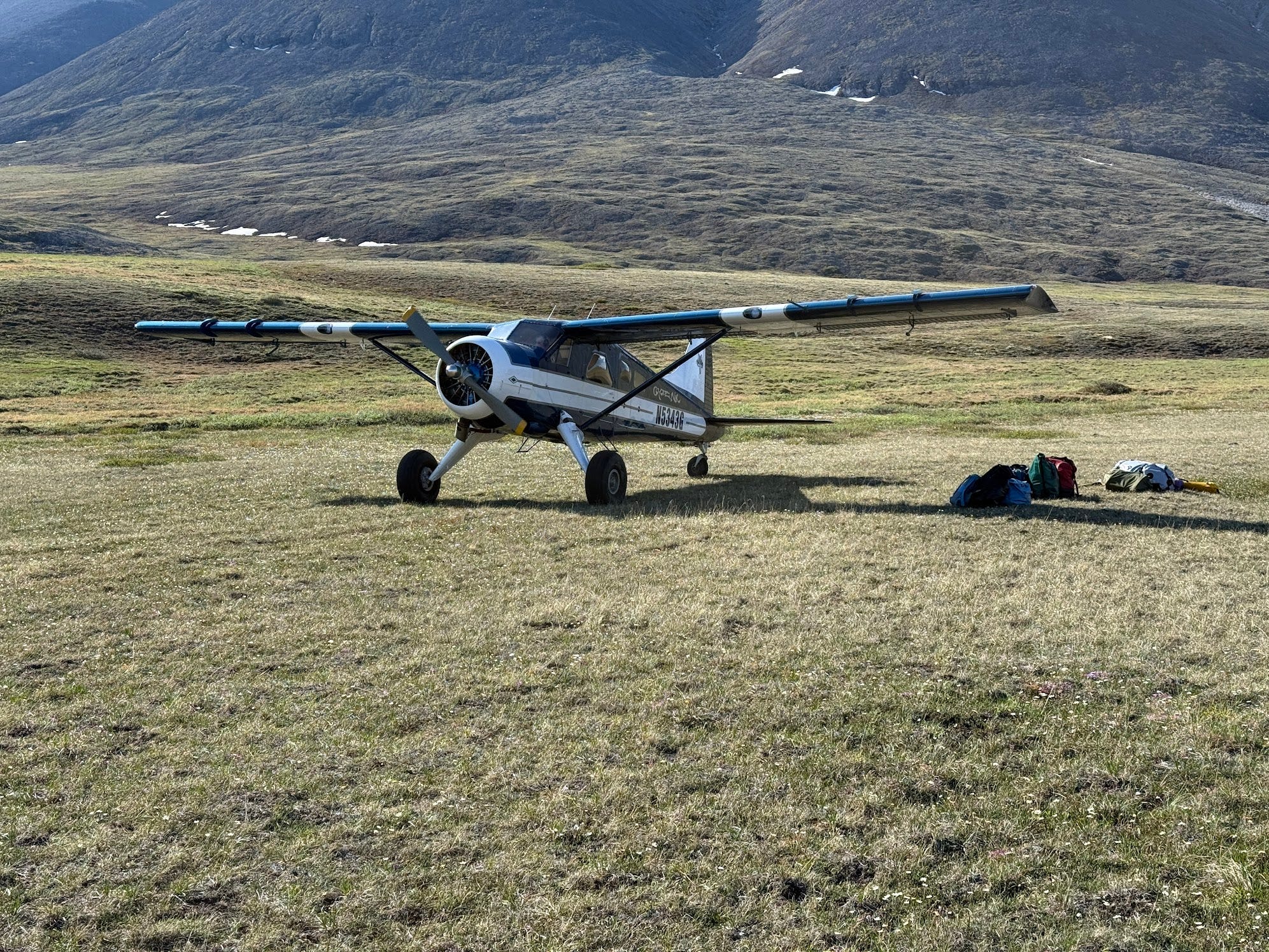
Once Dirk flew away, we were the only people around for more than a day’s travel by the only means available to us: our feet. No roads. No phone service. No internet. No electricity. No buildings. No running water.
Though that last one is not quite true, because there was a lovely stream running right beside camp, fed by melting snow from the hills above us. It was running water in the most literal and least municipal sense. By the time we left, it had almost dried up, which made me feel a little like we had arrived just in time to borrow it.
It was a very different kind of existence. Primordial, maybe. Edenic. But of course, we weren’t really outside human culture. Not remotely.
Each of us had a tent and a sleeping bag that kept us warm. We had sunscreen for the sun that never set during our five days there, which is a phrase that sounds romantic until you are trying to convince your body that yes, it is actually bedtime even though the world looks like 4:30 in the afternoon. We had REI rain suits, which we used only once but were very glad to have when we needed them. We had hiking boots, wool socks, synthetic layers, bug spray, cameras, and plastic bags.
We had good food packed in bear-proof containers. We had coffee, which I mention separately because coffee is not merely food. Coffee is civilization in liquid form.
And we had community. That may have been the most important aspect of human culture we brought.
Other species live in groups, of course. Some have relationships that can only be called friendships. A few even seem to use something like names for each other. I don’t want to overstate human uniqueness in a place where the animals had already begun quietly correcting my assumptions. But our little community had something that pulled us into deeper relationship with remarkable speed: language, story, and religion.
In the evenings, sitting around camp, we took turns telling our life stories. There was no program for this, no laminated discussion guide, no “three vulnerable questions to build trust among faith leaders in the Arctic wilderness.” We just talked. Someone would begin. The story would start with the usual facts: where they were born, who was in the family, what they studied, what work they had done, how they got from there to here. But before long the facts would open into something deeper. The story would become a confession of what had wounded them, sustained them, called them, confused them, broken their heart, and gave them joy.
It was holy.
I don’t use that word lightly. Or maybe I do sometimes. But this was holy in the old sense: set apart, charged, not fully manageable.
Our group was wonderfully unlikely. Here we are from left to right:
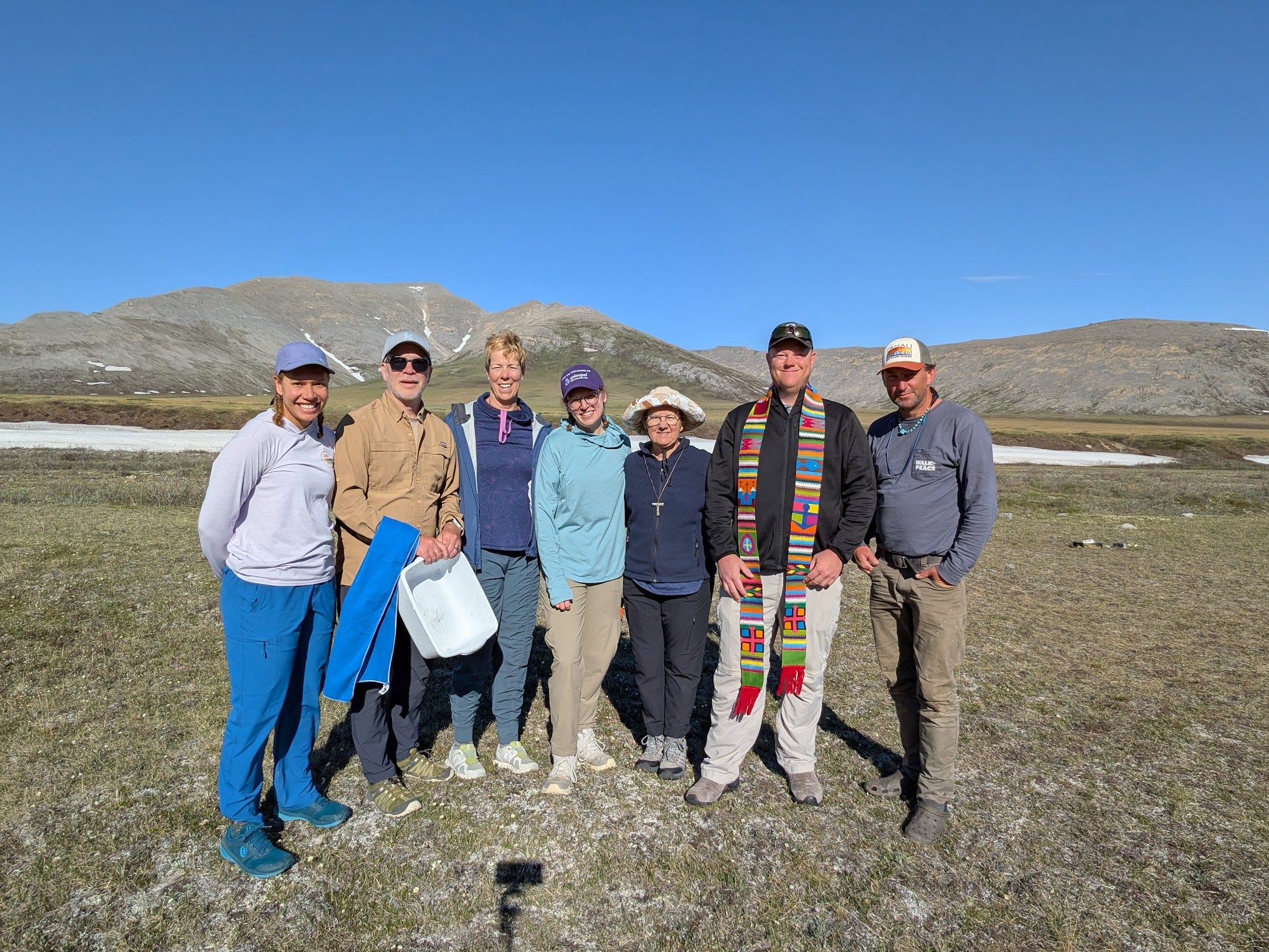
First is Natalie, the staff person from American Lands Project, who organized the whole trip. She was the youngest of us but carried the competence of someone you would fully trust to stay on top of all the contingencies you might experience in the Alaskan wilderness. And she was delightful to be around.
There is me, representing the Mennonite tradition, though I did not actually wash anyone’s feet. Not because they didn’t need it. We were five days into wilderness camping. Let’s just say the theological opportunity was there but not taken advantage of.
Next is Courtenay, who went to seminary and became a pastor in her fifties, now serving a Presbyterian church in Philadelphia. She brought grace, wisdom, and humor in exactly the proportions one hopes for in a traveling companion.
Then Susie, who works on climate and environmental policy in D.C. for the Episcopal Church and knows more about these issues before the age of thirty than I will ever hope to know. She had the slightly unnerving combination of intelligence, moral clarity, and youth that makes the rest of us both grateful and mildly embarrassed.
Next to her is Sister Joan, a seventy-three-year-old Franciscan nun, at home in the wilderness and somehow also at home with God in ways that made the rest of us at home with different expressions of spirituality. She was the mystical heart of our group.
Then Andrew, a lawyer and minister, with an already impressive career of looking out for the “least of these” both legally and spiritually. He was the sort of person who could talk policy, law, Scripture, and fishing and make them all sound like the most enjoyable thing you’d ever do.
And finally there was our guide, chef, protector, wilderness tutor, and general guardian angel, known to everyone as Country. I assume he has a legal name of some kind, because the government usually insists on such things, but “Country” seemed not only sufficient but inevitable. There is no one in the world I would rather have had in those capacities in the Alaskan wilderness.
Being drawn into the lives of these people was one of the great gifts of the trip.
And maybe that is part of why I didn’t write much while I was there. Writing can be a form of attention, but it can also become a form of abstraction or even retreat. I know how to step back from an experience and begin arranging it into paragraphs while it is still happening. Sometimes that is useful. But sometimes it is a way of avoiding the full force of what is in front of me.
In ANWR, I did not want to turn the place too quickly into content. I wanted to let the land be land. I wanted the people to be people before they became characters in an essay. I wanted the cold, wind, sun, mosquitoes, laughter, prayers, river crossings, awkward biological chores, and long silences to do their work before I started explaining them.
So that is what I tried to do.
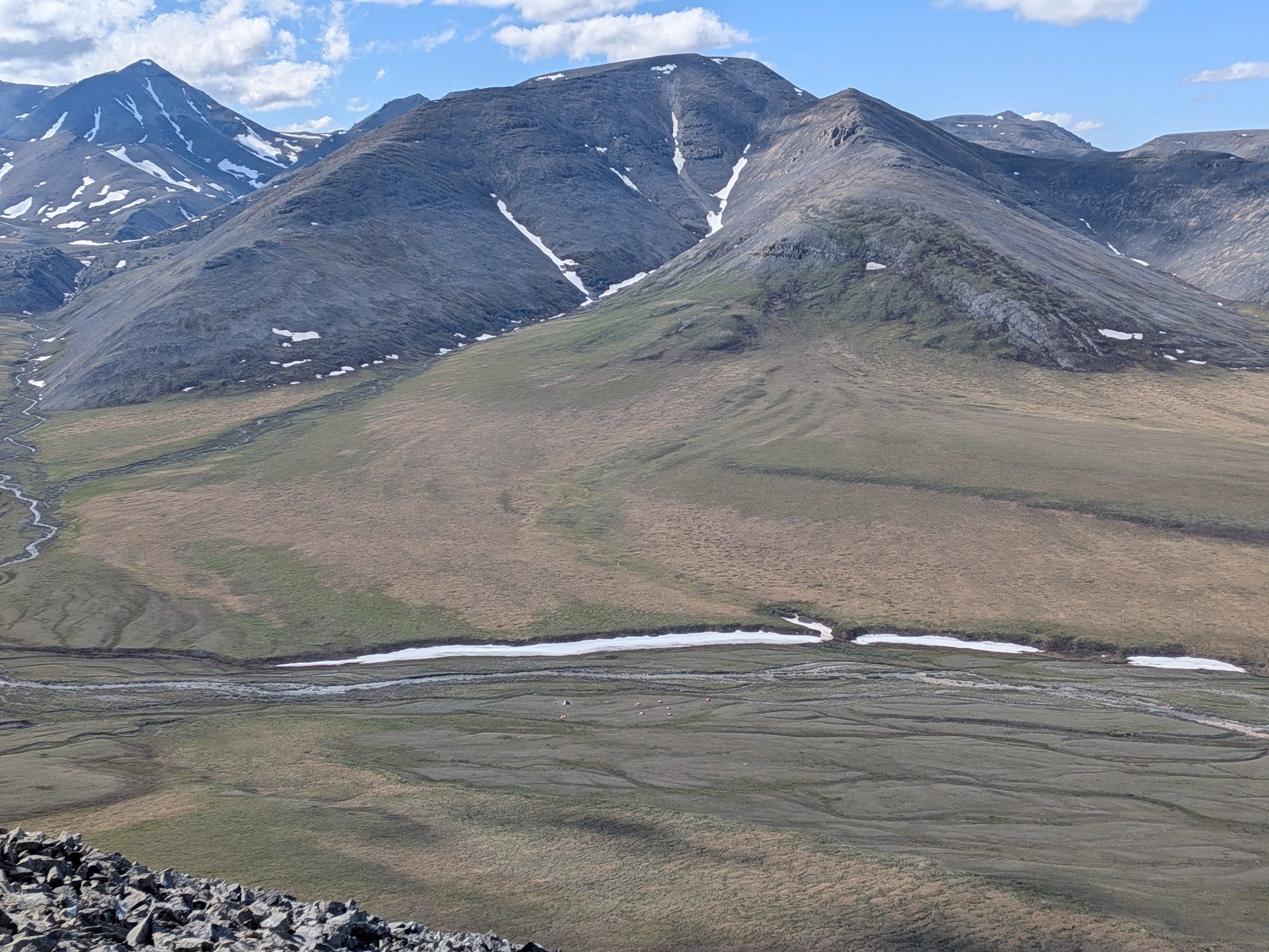
Now I’m home, and the explaining begins. Or at least the witnessing does.
Instead of giving you a day-by-day summary — Saturday we walked here, Sunday I slipped in that stream, Monday the mosquitoes achieved spiritual victory over me — I’m going to write a series of reflections on what I took away from the trip. There will be plenty of pictures, because I took many. But mostly I want to bear witness to this place.
In future installments I’ll write about the animals I saw, and Job’s strange invitation to “ask the beasts” what they know.
I’ll write about the word “refuge”, and whether protecting a place like ANWR is not only about protecting vulnerable animals, but also about testing our own capacity for restraint.
I’ll write about why we should care about a place most of us will never visit, a place far beyond the roads, beyond the cell towers, beyond the reach of our ordinary habits of attention.
But before I could write about any of those things, I had to look. I had to really look.
Now the looking is done and the writing has begun.
Stay tuned.
You know how much I like to comment on your posts. But now I have only word: Amen.
I know exactly what you mean by refraining from writing. At the very same time, I am so enjoying your beautiful writing! Thank you for sharing this experience in whatever way is possible in words.