Babel versus Nehemiah
A cheeky reflection on the Pope’s AI encyclical

I wrote a more serious piece this week for BioLogos about Pope Leo XIV’s new encyclical on artificial intelligence, Magnifica Humanitas. This installment of my occasional newsletter is a kind of companion piece to that… with just as much seriousness, but a little more impiety and a lot more words (the kind of thing you write on an airplane, when there’s not much else to do and a long time to do it in!).
The encyclical is more than 42,000 words long, which means there’s a pretty good chance it will become the most AI-summarized document in the history of Catholic pronouncements. I’m guessing there are a bunch of server farms right now churning through tokens in response some internet commentator who outsourced their reading and judgment of the document to an LLM. It’s responding with, “In summary, Pope Leo raises serious concerns about outsourcing human judgment to machines.”
I assure you I read the whole thing myself. Not because I’ve sworn off all use of AI (as you’ll see momentarily). But mostly because I had a couple of days of unstructured work time this week, and I can’t resist the pretentiousness of being able to say, “Well actually, in paragraph 198…” which I did multiple times in the BioLogos article.
Here I’ll mostly dwell on the memorable biblical contrast Pope Leo gave us for thinking about AI: is it like the Tower of Babel, or is it like Nehemiah’s rebuilding of the wall around Jerusalem? That’s pretty good. He must have a team of Vatican research assistants who came up with that… or maybe he used AI to help him come up with a memorable biblical metaphor for how good Catholics should think about AI?
OK, I just asked ChatGPT to come up with a memorable biblical metaphor for how good Catholics should think about AI. It said:
AI is like the bronze serpent in the wilderness.
In Numbers 21, the Israelites are bitten by serpents, and God tells Moses to make a bronze serpent and lift it up on a pole. When the people look at it, they are healed. But later, in 2 Kings 18, that same bronze serpent has become an idol, and King Hezekiah has to smash it.
That is a nearly perfect biblical metaphor for AI.
Hmm… “Nearly perfect” if it does say so itself? Not quite as good in my book. I’m back to the theory about the Vatican research team. The OT construction project metaphor is fruitful for thinking about AI. Maybe too fruitful… because once you start seeing the AI race through this lens, it is hard to stop. (You’ll see what I mean if you make it all the way through this post!)
Babel, you’ll remember, was humanity’s attempt to build a tower reaching to the heavens, “to make a name for ourselves.” That would be an honest mission statement for most venture-backed startups. The pitch deck practically writes itself:
Slide 1: The Babel Project: Scaling Human Ambition Since Genesis 11
Slide 2: Problem: Humans are geographically dispersed and insufficiently famous
Slide 3: Solution: One tower, one language, one brand identity
Slide 4: Market Opportunity: Total existential dominance
Slide 5: Risks: Divine judgment, linguistic fragmentation, user churn
I’m joking. Mostly. And full disclosure: I asked ChatGPT to give me a pitch deck for the Babel Project… I’m not sure what “user churn” even is.
To be clear, the Babel story is not anti-technology. Bricks and mortar are not the problem in the story. The problem is technological achievement that has been severed from community and the good of the vulnerable. Babel might be read as building “because we can”, developing greater efficiencies and scaling things up without the discernment of whether we should.
Sound familiar?
Nehemiah’s wall gives us a different image. After Jerusalem was devastated and had lain in ruins, Nehemiah organized people to rebuild the city’s walls. It wasn’t glamorous or an attempt to create a monument to human greatness. It was a shared work of protection, repair, and communal responsibility.
It’s possible that I’m pushing the Pope’s metaphor further than he intended (and probable that it’s further than good taste should allow), but it seems to me that we can make a series of contrasts:
Babel says, “Look what we can build.” Nehemiah says, “Look who needs protecting.”
Babel might have better branding. Nehemiah has better theology.
If Babel had a launch event, there would be smoke machines. If Nehemiah had a launch event, someone would forget to bring enough folding chairs.
Babel would have a sleek logo, probably a tower-shaped “B” in a futuristic font. Nehemiah would have a sign-up sheet in the back and someone named Linda asking whether you can bring a casserole for the workers on Thursday.
Babel would have an influencer strategy and say, “We’re building the future.” Nehemiah would say, “Can you take this section of wall? Also, please bring your own trowel.”
Babel would hire a Chief Vision Officer. Nehemiah would ask whether anyone had checked on the elderly couple whose house is near the broken gate.
Babel would ask, “How high can we go?” Nehemiah would ask, “Who is still exposed?”
OK, this is getting ridiculous, but that last couplet of questions is the one I hope sticks with you. Because the central question about AI is not whether it can write, calculate, diagnose, translate, persuade, generate images, compose music, or summarize papal encyclicals faster than we can. It can already do many of those things remarkably well, and it will only get better.
The question is what kind of people we are becoming as we build it. And just as importantly: who is being left outside the wall?
Pope Leo’s encyclical is not mainly worried that machines will become too human. It is worried that humans will become less human by its constant use, that we will start imitating its form of intelligence: fast, frictionless, disembodied, optimized, and untroubled by love.
Machines can calculate and pattern-match. They can simulate conversation. They can generate relevant and readable paragraphs of text in less time than it takes me to get half-way through my first cup of coffee. But moral judgment is not calculation, the Pope claims. Care is not content generation. Wisdom is not prediction. Love is not optimization.
One of the most poignant sections of the encyclical comes when Pope Leo talks about ordinary acts of care: reading stories to children, keeping company with the elderly, making a home welcoming (paragraph 114, if you’re interested!). These are the sorts of things that our technological imagination is tempted to treat as inefficient and needing optimization. Surely we can automate some of this! Surely we can make it smoother, cheaper, more scalable!
Maybe we can.
Maybe an AI can read a bedtime story with better character voices than I can. Fine, I concede. But the point of reading to a child is not only that the child receives narrative content before sleep. The point is that someone is there. A breathing, embodied, interruptible, perhaps even irritable, someone.
Someone who mispronounces a word and gets corrected. Someone who is tired. Someone who smells faintly of mown grass or laundry detergent or the day’s accumulated stress. Someone who could be doing something else but has chosen this.
I think all that still matters. But it’s not my main point or critique of AI, at least partly because it is susceptible to the rebuttal: but we could synthesize all that in a very believable way. We can make the AI sound irritated!
Ok, maybe. But my bigger claim is that reading to the child matters for the reader too. We become certain kinds of people by doing the slow, inefficient, tender things. We ourselves are formed as mature humans by acts of care. That can’t be outsourced any more than I can outsource someone to go to the gym and exercise for me (have I said that in these pages yet?? I’ve been saying it a lot lately.)
Care is not merely a service delivered to someone with a need. It is a school for the soul.
All this connects pretty well to something in the book manuscript I just turned in, The Spiritual Journey of Homo Sapiens. In it I ask how we became the kind of creatures capable of moral responsibility and spiritual maturity. We are not simply brains on sticks, and we are not just information-processing devices with unusually strong opinions about coffee. We are embodied, social, meaning-making animals. We became human through seeing, walking, thinking, talking, feeling, choosing, and loving (that’s not meant to be an exhaustive list… just the chapters in my book).
Love for humans has a peculiar problem: it keeps expanding. That is both our remarkable evolutionary achievement… and our burden to bear.
For most of human history, our moral world was small enough to be encountered in the flesh. You knew the people in your village. You saw who was hungry. You heard who was sick. You knew who had been widowed, who needed help with the harvest, who was feuding with whom, and who kept borrowing your tools without returning them.
Now my phone informs me before breakfast about suffering on all the continents: ecological collapse, war crimes, refugee crises, exploited workers, dangerous viruses, lonely teenagers, abused children.
Our awareness of needy neighbors has scaled up. Our capacity to love all those we encounter has not automatically scaled with it.
This, I think, is one of the great spiritual challenges of the technological age. We know more than we can emotionally bear. We are connected to more people than we can responsibly attend to.
The archetype of neighbor-love, The Good Samaritan, stopped for the wounded man on the road because the wounded man was, quite literally, in his path (the church people had to cross to the other side to avoid him if I’m remembering correctly). But what happens when the “road” we’re on is not confined to the space around us?
What happens when my “neighbor” is a sick and homeless child on the other side of the world, whose image flashes across my screen for three seconds between an ad for hiking pants and a recipe for sheet-pan gnocchi? Did I encounter a neighbor?
What happens when I learn of people in my own country who have higher rates of cancer because they live in an area that has been contaminated for generations by industrial runoff? Would a good neighbor do something about that? The examples could be multiplied endlessly.
If we’re going to keep growing as a species on this spiritual journey, our capacity to love our neighbor needs to be scaled up. There are more needy neighbors than we can individually love. But we have figured out how to scale our capacities through institutions.
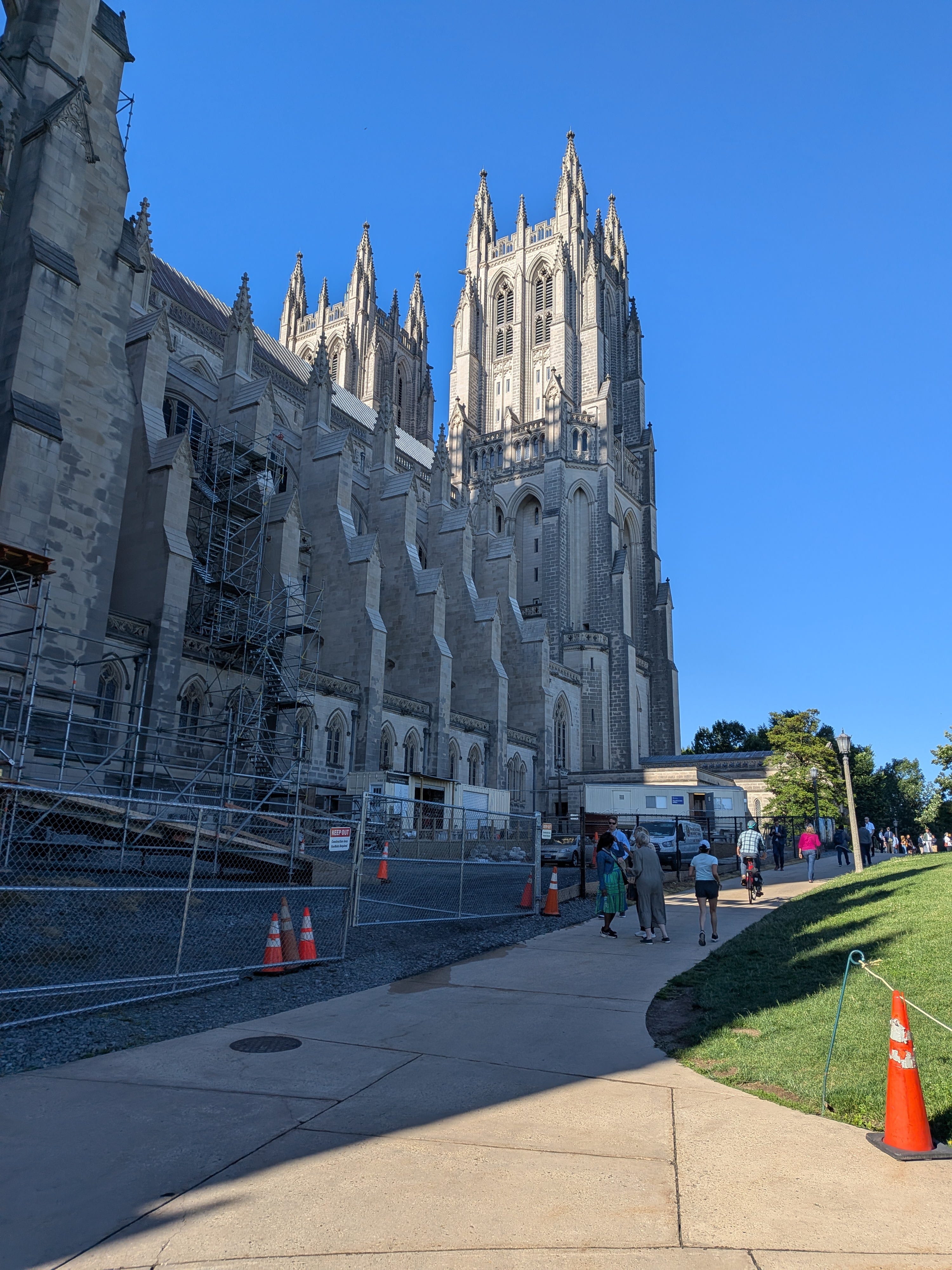
I’m traveling home from a few days in DC at the Understory Festival. It’s been a feast of ideas and art about what might be growing beneath the canopy of culture, particularly among Christians who feel there has got to be a better way to love our neighbors than politics is offering right now. There was a lot of attention paid to institutions: from small families and local food pantries, all the way up to governments and transnational tech companies (which the Pope fears are beyond government’s accountability). All of these can help us be more loving or they can magnify our less noble drives.
Personal compassion still matters. But in a technological civilization, neighbor-love must also take institutional form. We need laws, companies, schools, churches, unions, nonprofits, professional guilds, public agencies, and international agreements that carry our moral concern farther than individual good intentions can reach.
That is one of the strongest points in Pope Leo’s encyclical. Charity has to become wider, systemic justice. Fraternity has to become institutional. Neighbor-love has to scale. Otherwise, Babel wins. Not because Babel is more persuasive, but because Babel is better organized.
This is the uncomfortable truth: Babel knows how to build. Babel knows how to raise capital, coordinate labor, standardize language, and move fast. Babel has metrics, dashboards, and KPIs. Babel does not get bogged down in awkward questions like “Should we?” or “Who suffers?” or “Is this making us more human?” or “Why is there no childcare at this meeting?”
Nehemiah’s wall repair project, by contrast, requires participation. It requires attention to place. It requires people taking responsibility for their section. It requires repair rather than spectacle. It requires noticing where the breaches are. And it requires staying close enough to the vulnerable to remember what the wall is for.
This is what I appreciate about the pope’s framing. He does not say AI is evil. He does not tell us to go live in caves (though long-time readers will know that I love a good cave!) or imagine that we can simply opt out of technological life. Instead, he asks what kind of moral world our technologies are building. That is the right question.
Technology is never neutral, I keep claiming. Not because every tool is secretly possessed by demons. I have a toaster, and I am reasonably confident it is not forming me into a worse person!
But technologies carry assumptions about what matters. They reward certain behaviors. They make some choices easier and others harder. They shape our attention, our desires, our language, and our sense of what is normal.
A shovel shapes the work of digging. A clock shapes our sense of time. A smartphone shapes our attention. A social media platform shapes our appetite for outrage, affirmation, and novelty. An AI system trained on massive datasets and optimized for profit, prediction, persuasion, or efficiency is not just a neutral instrument waiting for a morally pure user. It already contains a vision of the human person.
The Babel vs. Nehemiah contrast matters. These are not just two construction projects. They are two visions of humanity (ready for one more metaphor-straining list?!):
Babel imagines human beings as units of coordinated power. Nehemiah imagines human beings as members of a vulnerable community.
If your AI project requires you to gather enormous amounts of human data without meaningful consent, concentrate power in the hands of a few, displace workers without protecting them, automate violence, manipulate attention, erode trust, and describe all of this as inevitable progress, you may be building Babel.
If your AI project helps doctors serve patients better, teachers attend to students more wisely, scientists understand creation more deeply, workers gain dignity rather than lose it, communities deliberate more honestly, and the vulnerable become less vulnerable, you may have found your section of Nehemiah’s wall.
If your system makes a few people unimaginably wealthy while turning everyone else into training data, Babel.
If your system helps people with disabilities navigate the world more freely, Nehemiah.
If your product roadmap includes the phrase “frictionless human replacement,” you’re building Babel. (Also, please repent.)
If your tool frees people from drudgery so they can do more meaningful work and give more attention to one another, Nehemiah.
If your AI helps generate 700 nearly identical blog posts so the internet becomes an infinite buffet of uninspired words, you’re Babel-ing (without a universal translator).
If your AI helps someone finally write the letter they needed to write, understand the diagnosis they were afraid to ask about, or communicate across a language barrier with a neighbor, that’s Nehemiah.
I know of AI being employed for all of those things I just listed. The line between the good uses and the bad uses will not always be obvious. And my point keeps being that there is more at stake that whether we use the tech for good or bad, but what it does to us in the process. Is it increasing our agency, our personhood?
I guess the moral in this long-winded rant is: we need discernment. We need communities capable of asking slow questions. We need people who are not dazzled by power simply because it comes wrapped in elegant packaging and design.
And maybe we need songs. That was the theme of my BioLogos article on the encyclical. Pope Leo ends the encyclical with Mary’s Magnificat from Luke chapter 1, which is fitting. Mary does not sing about domination, speed, scale, optimization, or market capture. She sings about mercy. She sings about the lowly lifted up and the powerful brought down from their thrones. She sings about God’s faithfulness to the vulnerable.
That’s not the sort of music you’d hear on the Babel construction site. If there is any music there, it’s just some variation on the workers singing, “Look down, look down, don’t look them in the eye” from the Les Miz soundtrack.
Mary’s song is different. It is not anti-building. It is not anti-creativity. It is not anti-technology. It is anti-idolatry. It refuses to confuse greatness with power.
And maybe that is where Christians can begin. Not with panic, nor with nostalgia, nor with pretending we can put the AI genie back in the bottle. But also not with baptizing every new tool because it might help us make sermon slides faster.
Maybe we can begin by asking better questions:
What are we building?
Who is it for?
Who is exposed?
Who profits?
Who bears the risk?
Who gets a voice?
What habits is this forming in us?
Does this help us love our neighbors, or does it help us avoid them?
Does this make us more human?
And then we take up our section of the wall.
Some of us will work on policy. Some on education. Some on ethics. Some on better technology. Some on protecting workers. Some on caring for children. Some on visiting the elderly. Some on writing about all of this.
Not all of it will look impressive. Some of the attempted repairs won’t work. But the future of humanity probably depends less on whether we can build machines that imitate us, and more on whether we can remain the kinds of creatures who read to children, sit with the lonely, tell the truth, protect the vulnerable, repent when we are wrong, and sing songs that remind us power is not the same thing as greatness.
Ok that got pretty long. And don’t take it all too seriously… but do please take it with the right amount of seriousness.
I am going to start with a joke. I asked AI which baseball team is the overall best throughout history. AI (not being an idiot) started with an answer calculated to avoid offence. “There is no single universally agreed-upon "best team" in baseball history”. It then mentioned the fact that such a judgment would depend on too many variables, but then admitted that “the title is almost exclusively awarded to a few historically legendary squads”. I dutifully clicked the “more” button. There I found a list of five teams named as examples of “a few historically legendary squads”. The New York Yankees appear three times (for three different seasons.) Four other teams are mentioned once. The team from Boston does not appear.
Now for the serious part. This piece is by far the best single thing I have read about AI, and it should be widely distributed and promulgated. I will discuss this with you shortly. Reading it, I was picturing you (seated on an aisle seat) typing the words into metaphors, homilies, exhortations, warnings, and lists upon lists. The presence of the Holy Spirit’s influence on paragraph and sentence formation, geared to shake the world, is obvious.
What I am trying to say is that this is a masterpiece of writing, Jim. (Much like your soon-to-be-released book). I encourage everyone reading it to share it and spread the word. I believe that a great deal depends on it, and I give enormous credit to the Pope for his Holy wisdom in addressing what is soon to become one of the most important issues in modern human existence.
Thank you very much.